



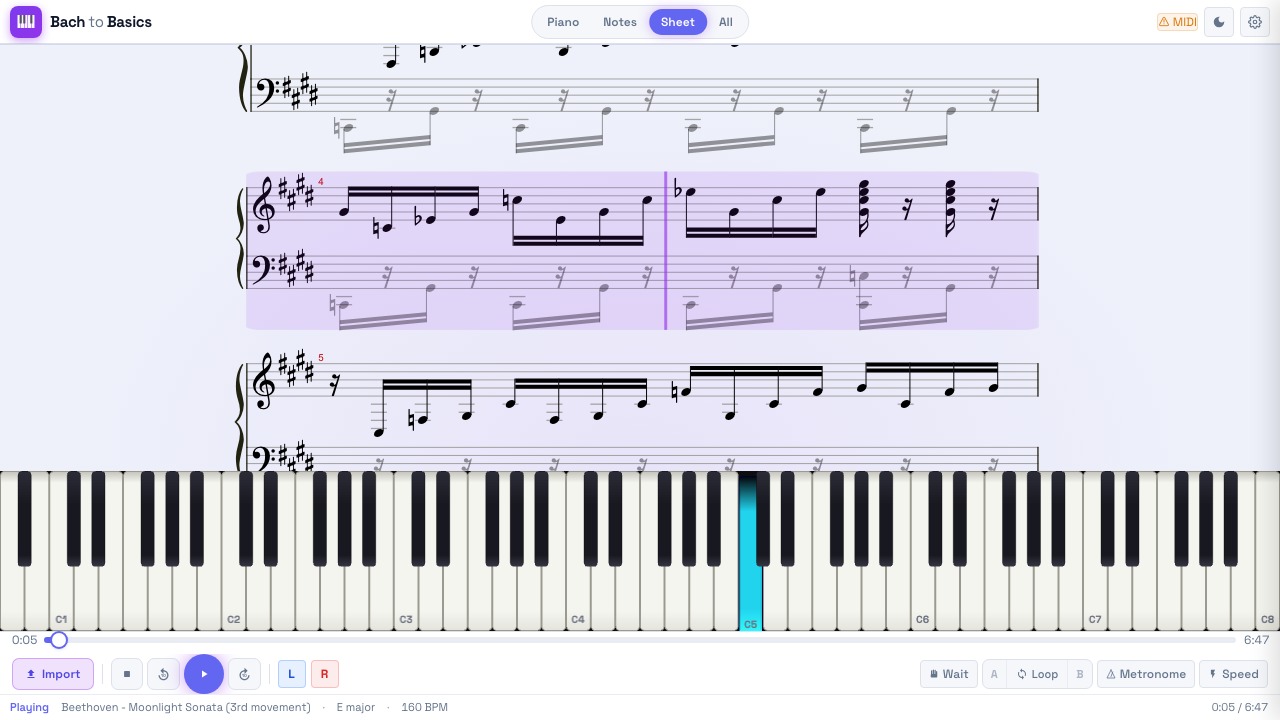
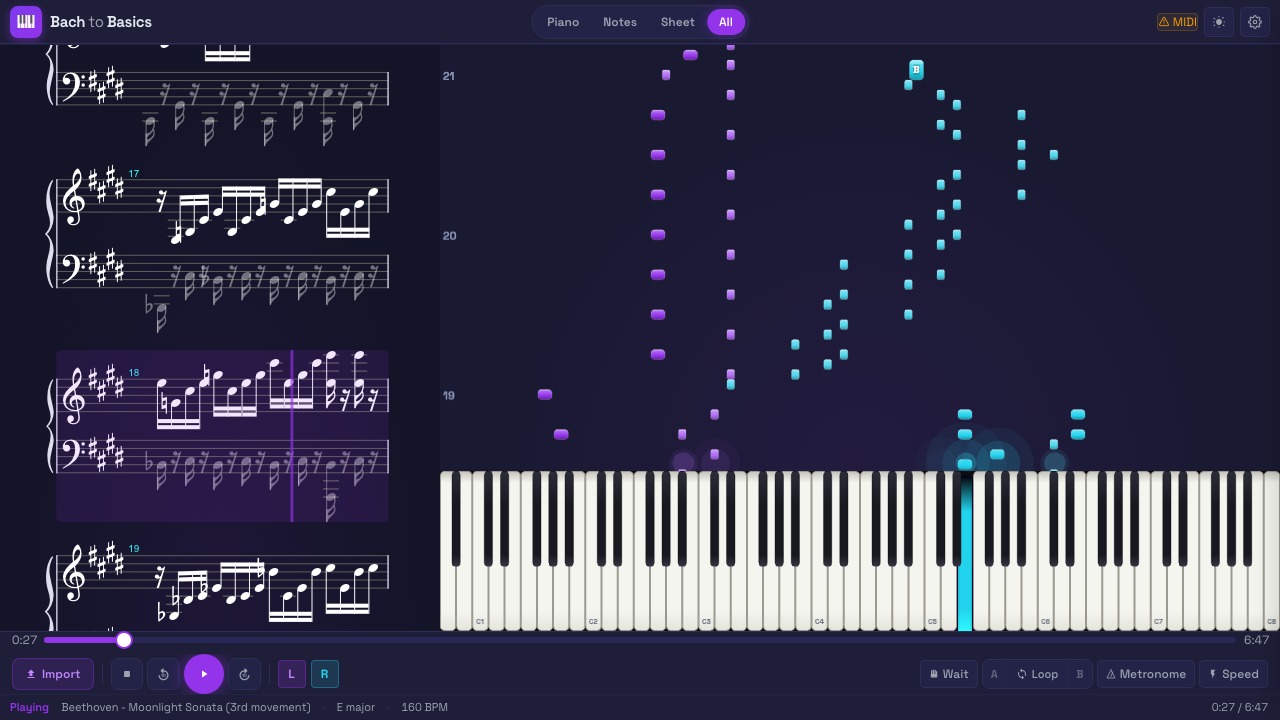
A browser-based piano practice tool. Drop in a MIDI file, a MusicXML score, or even a PDF of sheet music. Bach to Basics turns it into synced views of falling notes, an interactive 88-key piano, and rendered sheet music, then layers on practice tools (A/B loop, speed trainer, wait mode, metronome, transpose) to help you learn the piece.
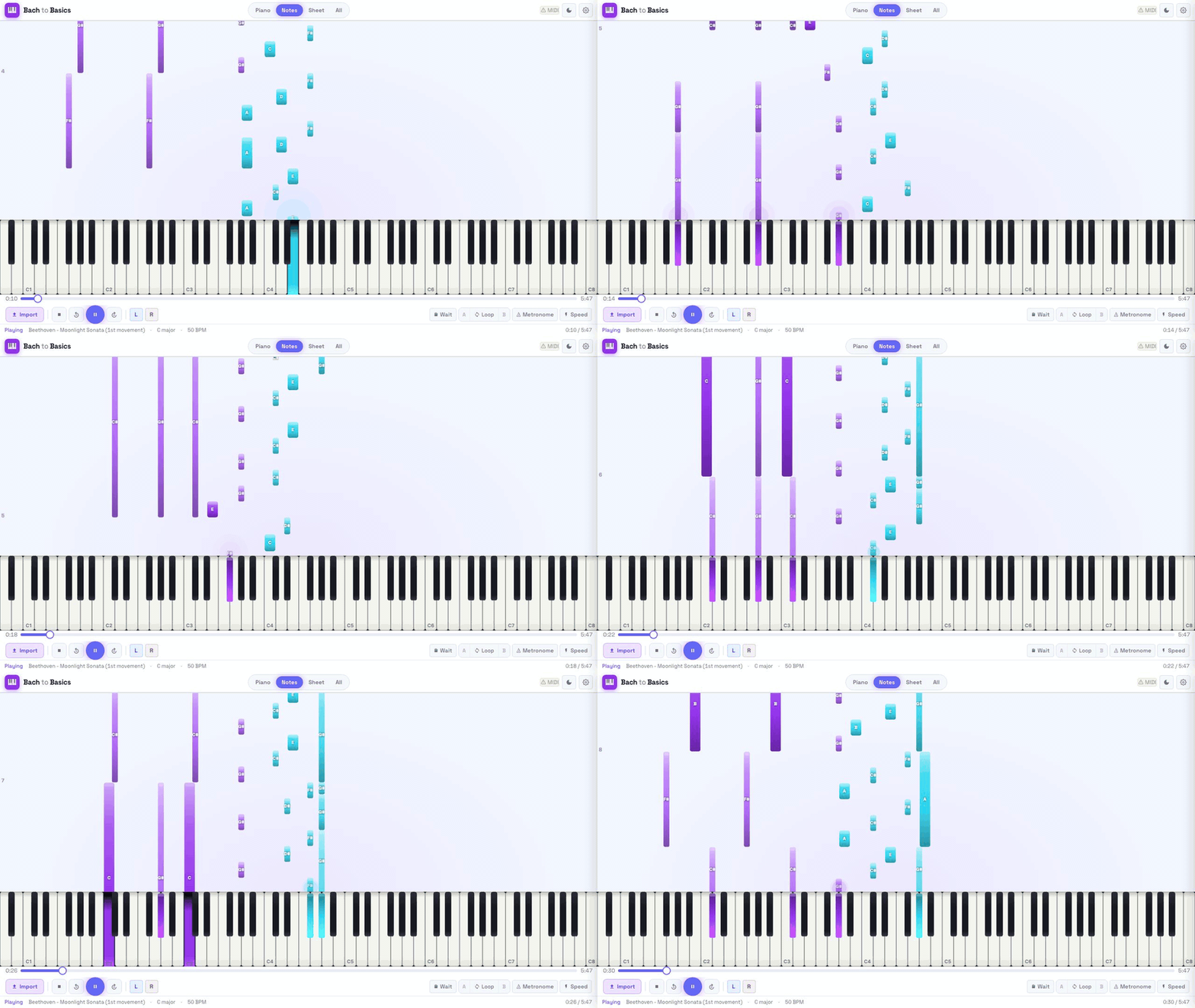
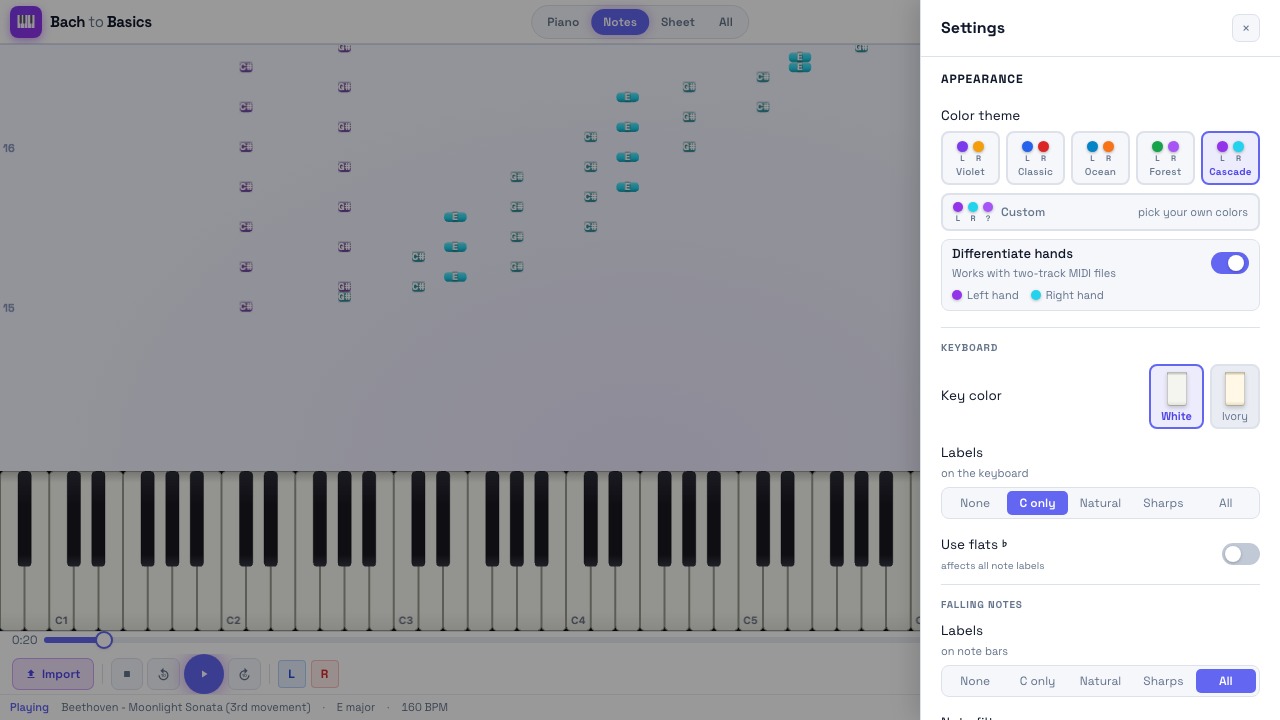
| Sheet music | All views | Settings |
|---|---|---|
 |
 |
 |
Features
Import
- MIDI (
.mid,.midi): parsed in a Web Worker, converted to MusicXML on the backend for sheet rendering - MusicXML (
.xml,.mxl): both uncompressed and compressed (zip-style) variants - PDF sheet music (
.pdf): optical music recognition via Audiveris to MusicXML, then to MIDI (optional setup, see below)
Drag-and-drop anywhere on the window, or use the import button.
⚠️ A note on import accuracy. Both PDF-to-MIDI (optical music recognition) and MIDI-to-sheet-music (notation reconstruction) are inherently lossy conversions. Expect some inconsistencies:
- PDF imports can mis-read notes, dynamics, ornaments, articulation, and voicing, especially with low-resolution scans, handwritten scores, or complex layouts. Audiveris is the best open-source OMR engine available, but no engine matches a careful human transcription.
- MIDI imports produce sheet music by re-deriving notation from raw note timings. MIDI doesn't encode key signatures, beaming, voicing, articulation, or enharmonic spelling, so the rendered sheet is an interpretation, not a faithful reproduction of the composer's original score.
For the cleanest sheet-music experience, import a MusicXML file (or
.mxl) when you have one, which preserves full notation semantics end-to-end.
Visualization
- Falling notes: Synthesia-style, GPU-accelerated via PixiJS. Hand-color separation, octave grid, measure numbers, optional beat lines, sustain-pedal indicators, ghost-notes-while-pedal-held, configurable impact effects (bloom / side burst / particle trail / off), and a "note outline" mode for high-contrast viewing.
- Sheet music: full notation rendering via AlphaTab, with auto-scrolling cursor that tracks playback. White background toggle so notation stays readable in dark mode.
- 88-key piano: interactive keyboard with hover, press depth, ivory or white key themes. Tap keys to play; drag across them to glissando.
Practice tools
- A/B loop with click-to-set markers; the loop region highlights across all three views
- Speed trainer: auto-ramps tempo on each loop pass (configurable start %, end %, step %)
- Wait mode: playback pauses until you play the correct note. Per-hand: wait for left only, right only, or both.
- Count-in: 0, 1, or 2 bars of metronome before the music starts
- Metronome: accent on downbeat
- Transposition: shift the whole score ±12 semitones
- Per-hand volume: solo or mute either hand independently
- Render-offset: shift audio scheduling ±200 ms to compensate for audio interface latency
Audio & MIDI
- 5 instrument options: Splendid Grand Piano, Bright Acoustic, CP80 Electric, Harpsichord, Honky-Tonk (sampled, via smplr)
- MIDI input via Web MIDI: connect a hardware keyboard (Roland, Yamaha, etc.); your input lights up the on-screen keys and drives wait mode
- Tempo control: 25%-200% with snap-back to 100%
Look & feel
- Color themes: Cascade, Violet, Classic, Ocean, Forest, or fully custom (left/right/unknown hand colors)
- Dark / light mode: system-aware initial theme, manual override
- Note labels: none, C-only, white keys, black keys, or all
Tech stack
| Layer | Technology |
|---|---|
| Frontend | React 19, TypeScript, Vite, Tailwind CSS |
| Rendering | PixiJS 8 (falling notes + piano), AlphaTab (sheet music) |
| Audio | Tone.js (scheduling), smplr (sampled instruments), Web Audio API |
| MIDI input | WebMidi.js |
| State | Zustand |
| Backend | FastAPI (Python 3.11/3.12) |
| Music processing | music21, defusedxml |
| OMR (optional) | Audiveris (Java) |
Running the app
Option A: Docker (recommended for end users)
The simplest way. Requires only Docker Desktop (or Docker Engine + Compose).
docker compose up        # build the images on first run, then start
open http://localhost:5173
That's it. Stop with Ctrl+C (or docker compose down).
Optional: copy
.env.exampleto.envand setBACKEND_API_KEYif you want to require an API key on the backend.
Option B: Native (recommended for development)
You'll need:
- Node.js 22+ and pnpm (
npm i -g pnpm) - Python 3.11 or 3.12
- Java 17+, only needed for PDF import via Audiveris
pnpm install
pnpm backend:setup      # creates backend/.venv with the core deps
pnpm dev                # frontend on :5173, backend on :8000, with hot reload
Optional: PDF import via Audiveris
PDF to MusicXML uses Audiveris, an open-source OMR engine.
- Download
audiveris.jarfrom Audiveris releases - Place it at
backend/bin/audiveris.jar - Make sure Java 17+ is on
PATH(Docker users: already included in the image)
Without the JAR, MIDI / MusicXML import still works, only PDF import is unavailable.
Using the app on iPad / iPhone (same network)
- In
frontend/vite.config.ts, addhost: trueto theserverblock (or runpnpm --filter frontend dev --host) - Find your computer's LAN IP (System Settings > Network on macOS)
- On the iPad, open
http://<your-ip>:5173
⚠️ Web MIDI is not available on iOS, the on-screen keyboard works, but you cannot connect a hardware piano via USB or Bluetooth from iOS Safari. This is a WebKit limitation Apple has not addressed.
Configuration
All backend settings come from environment variables. Copy .env.example to .env and edit.
| Variable | Default | Description |
|---|---|---|
ALLOWED_ORIGINS |
http://localhost:5173 |
Comma-separated list of allowed CORS origins |
BACKEND_API_KEY |
(unset = open) | When set, all requests must include X-API-Key: <value> |
REQUIRE_AUTH |
(unset) | Set to 1 to make the server refuse to start if BACKEND_API_KEY is not configured - useful for preventing accidental open deployments |
RATE_LIMIT_PER_MIN |
60 |
Max requests per IP per minute. 0 disables it |
HEAVY_RATE_LIMIT_PER_MIN |
10 |
Stricter limit applied to expensive endpoints (/omr/, /youtube/) |
TRUSTED_PROXY_IPS |
(unset) | Comma-separated IPs of trusted reverse proxies. When set, the real client IP is read from X-Forwarded-For instead of the connection address |
MUSIC21_TIMEOUT_S |
60 |
Hard timeout (seconds) for music21 conversions (MIDI-to-MusicXML, MusicXML-to-MIDI). Raise for very dense scores |
AUDIVERIS_TIMEOUT_S |
120 |
Hard timeout (seconds) for Audiveris OMR. Raise for large or multi-page PDFs |
Web MIDI requires HTTPS in production. Plain
http://only works onlocalhost.
Project layout
bach-to-basics/
├── frontend/                     # React app (Vite)
│   ├── src/
│   │   ├── components/
│   │   │   ├── FallingNotes/     # PixiJS falling-note renderer
│   │   │   ├── PianoKeyboard/    # PixiJS 88-key keyboard
│   │   │   ├── SheetMusic/       # AlphaTab sheet music view
│   │   │   └── Transport/        # Transport bar + settings panel
│   │   ├── engine/               # SyncEngine, AudioEngine, MidiClock
│   │   ├── store/                # Zustand app state
│   │   ├── utils/                # Shared utilities
│   │   ├── views/                # PracticeView (main layout)
│   │   └── workers/              # MIDI parsing in a Web Worker
│   └── public/                   # Static assets (soundfont)
├── backend/                      # FastAPI backend
│   ├── routers/                  # transcribe, omr, youtube, export, fingering
│   └── services/                 # blocking work (music21, Audiveris, etc.)
├── shared/                       # TypeScript types shared with the frontend
├── docker-compose.yml            # 1-command run for end users
└── package.json                  # pnpm workspace root
Browser support
Requires a Chromium-based browser (Chrome, Edge, Brave, Arc) for Web MIDI API support. Firefox and Safari don't implement Web MIDI; on those, the on-screen keyboard still works but hardware MIDI input does not.
Roadmap
The backend already exposes endpoints for several features that don't yet have UI hooks:
- Audio-to-MIDI transcription via Basic Pitch (
/transcribe/mp3) - YouTube-to-MIDI via yt-dlp + Basic Pitch (
/youtube/extract), sync data model already in place - Auto-fingering via pianoplayer (
/fingering/generate) - Export to PDF / MP3 / MIDI / MusicXML (
/export/pdf,/export/mp3)
These will become user-facing in upcoming releases. PRs welcome.
Troubleshooting
Sheet music doesn't render after loading a MIDI file
The MIDI-to-MusicXML conversion runs on the backend. Check that the backend is up (curl http://localhost:8000/health should return OK) and look at the backend terminal for music21 errors. Very dense scores can hit the MUSIC21_TIMEOUT_S (default 60s); raise it if needed.
No sound from the on-screen piano
The first interaction (any click) wakes the audio context. If you still hear nothing, open DevTools > Console and look for errors related to AudioContext or sample fetches from danigb.github.io / gleitz.github.io. Some corporate networks block these CDNs.
"WebMIDI not supported" on Firefox or Safari
Use Chrome, Edge, Brave, or Arc. Firefox and Safari haven't implemented Web MIDI.
PDF import says "OMR engine not available"
Either Audiveris isn't installed, or audiveris.jar isn't at backend/bin/audiveris.jar, or Java 17+ isn't on the PATH. See the PDF import section above. MIDI and MusicXML import are unaffected.
Docker build fails on the frontend
The frontend Dockerfile uses the repo root as build context to read pnpm-workspace.yaml and shared/. If you've moved or renamed those, update docker-compose.yml's build.context accordingly.
Contributing
See CONTRIBUTING.md. Bug reports and PRs welcome.
License
MIT for this codebase.
Third-party components (AlphaTab, music21, etc.) keep their own licenses, see NOTICE for the rundown. Notably:
- AlphaTab is MPL-2.0 (per-file copyleft), fine for both open source and commercial use as long as you don't modify AlphaTab's own files.
- Audiveris is AGPL-3.0 and is not bundled, users download it separately, so this repo doesn't inherit AGPL obligations.